
Aug 11
2026
Micro World Models
Compact vision models that observe locally and build a shared, actionable view of the physical world.

Now open
A shared view of the physical world
Many small models. One coherent view of what is happening.
Micro World Models are compact specialists that stay close to the work. Each model turns its local camera view into a precise observation; together, those observations create the context an agent needs to understand what changed and what matters next. Liquid Crow is our first compact vision model for this direction.
The complete public release lives in one place on Hugging Face, including the LoRA adapter, ONNX and quantized ONNX graphs, GGUF runtime files, processor configuration, integrity manifests, code examples, and an example video.
Why Micro-World Models?
Physical context requires understanding spaces as a whole. In a factory, information about a person, robot, tool, or material only becomes meaningful in relation to the rest of the physical environment—and that physical context is what gives a decision its value.
That requires more than one model looking at one crop at a time. We want multiple small, responsive models running in parallel, each attending to a different part of the scene and contributing a precise observation to a shared understanding of the world.
See the whole factory
A useful decision depends on context: the machine, nearby agents, materials, people, and the state of the environment around them.
Attend in parallel
Multiple small models can watch different regions and events at once, then contribute their observations to a shared description of the scene.
Respond where it matters
Compact specialists can remain close to physical agents, react quickly, and focus compute on the task directly in front of them.
Our Initial Results
Same scene, Two Different Worlds
For smaller models, the value is performance—but the cost of reducing size is cognition. Small models suffer from catastrophic repetition and other issues, including poor or shallow descriptions of a scene. We changed that with supervised cognition compression (SCC). The following results were measured on CPU only using a 0.5B-parameter model trained with SCC.
Loading measured outputs…
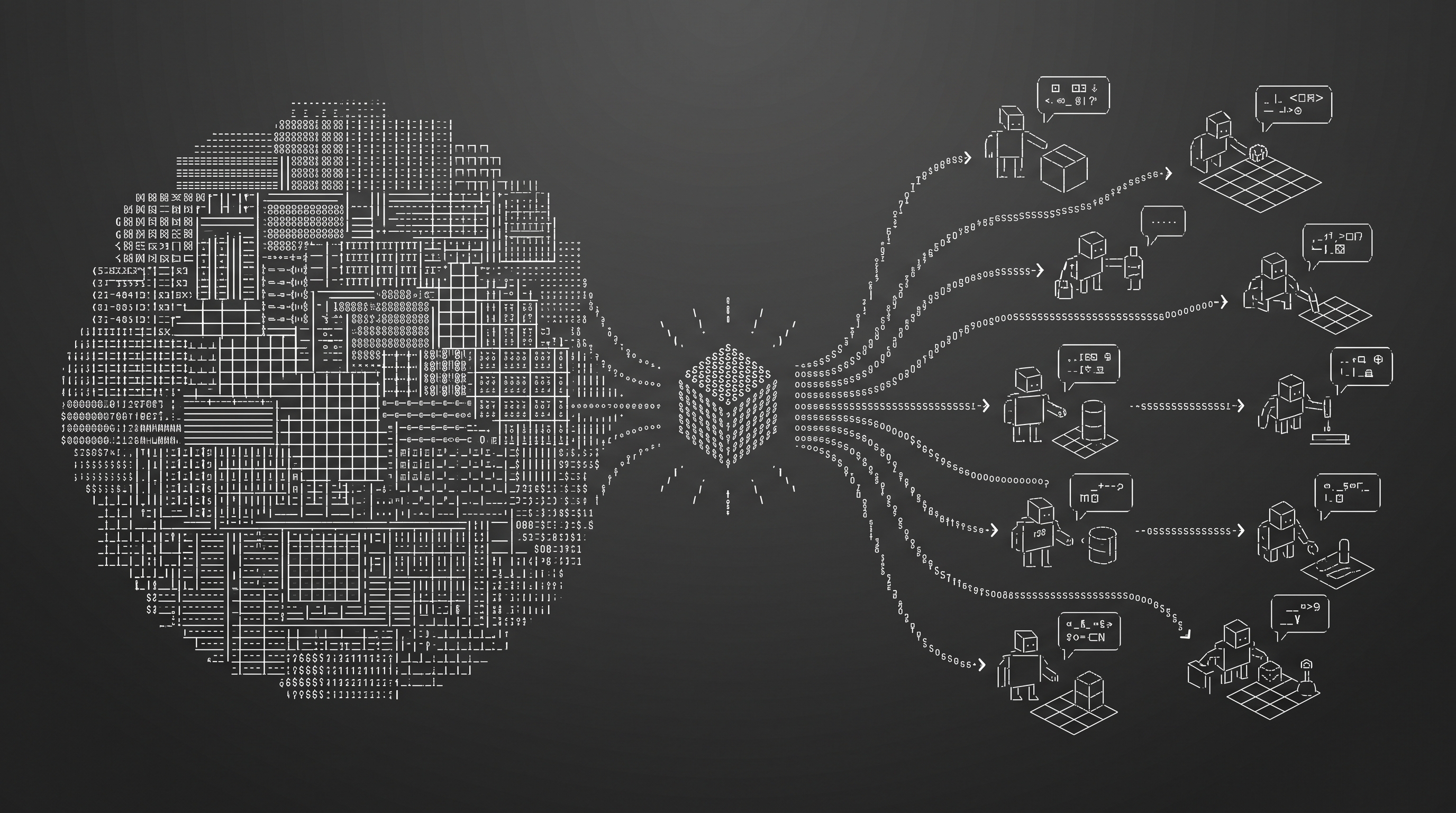
How? Small data, high cognition
The point is not data size by itself. It is how much useful cognition can be compressed into each training example: relationships, state, uncertainty, and the reasoning needed to describe a physical scene precisely.
Cognition compression also creates a path toward greater energy efficiency: smaller specialist models require less compute per inference and can avoid repeatedly sending every observation to a large remote model. The exact energy savings still depend on the hardware, workload, and deployment architecture.
Find the cognition core inside the information field.

A large corpus can contain mostly redundant information. A smaller corpus can carry a stronger learning signal when its examples encode the structure of the task.
Compress cognition into a model that can live with the agent.

The objective is not smallness by itself. It is to preserve useful physical-world cognition while reducing the model enough to run many responsive specialists in parallel.
Our prepared corpus occupied only 0.183 GB. It contained 40,500 text and agent-trace examples, and the selected step-2,000 checkpoint had seen 32,000 of them. We used LoRA to update around only 1% of the parameters while keeping the vision tower frozen.
This technique is memory and cost efficient in both training and inference.
- Prepared examples
- 40,500
- Seen by step 2,000
- 32,000
- Trainable parameters
- 1.57%
- Vision tower
- Frozen
A broader direction
This aligns with what experts say
The same distinction—between accumulating information and extracting reusable cognition—is becoming central to how researchers discuss the next generation of intelligent systems.