
Sep 3
2026
LVL-1 · 100M parameters
LVL-1: A 100M Parameter Micro-World Model
LVL-1 does not ask one small model to learn vision from scratch. It extracts different kinds of spatial evidence from specialized visual models, then compresses that evidence into a 100M-parameter language core.
01 / The question
Spatial knowledge is not one thing
A useful description of a physical scene must preserve several kinds of evidence at once: what is present, where it appears, how surfaces and objects are arranged, and what interaction is unfolding.
Object identity is semantic knowledge. Boundaries, parts, and relative position are local and dense knowledge. Relations such as above, inside, held by, or approachingrequire those visual signals to survive long enough to become language.
LVL-1 is an experiment in extracting those specific priors from specific models. It is not a metric 3D reconstruction and it does not maintain a world state through time. It turns one image into a compact, local observation that another spatial system can retain, compare, or reject.
02 / The sources
Ask each model for the knowledge it already has
LVL-1 freezes two complementary visual encoders and trains the bridge into language. The architecture is deliberately asymmetric: the visual models carry the expensive priors; the small decoder learns which evidence to preserve and how to express it.
SigLIP 2 Base
Semantic localization
Supplies language-aligned object and region meaning. SigLIP 2's training explicitly improves localization and dense features, while its NaFlex variant preserves native aspect ratio.
SigLIP 2 paperDINOv2 Small
Dense visual structure
Supplies self-supervised image and pixel-level features that transfer to tasks such as segmentation and depth. In LVL-1, that lane contributes shape, part, texture, and layout cues.
DINOv2 paperARC-Text 100M
Relational serialization
Receives a learned 131-token visual prefix and turns selected evidence into concise English. It is the compression and expression layer—not the source of the visual representation.
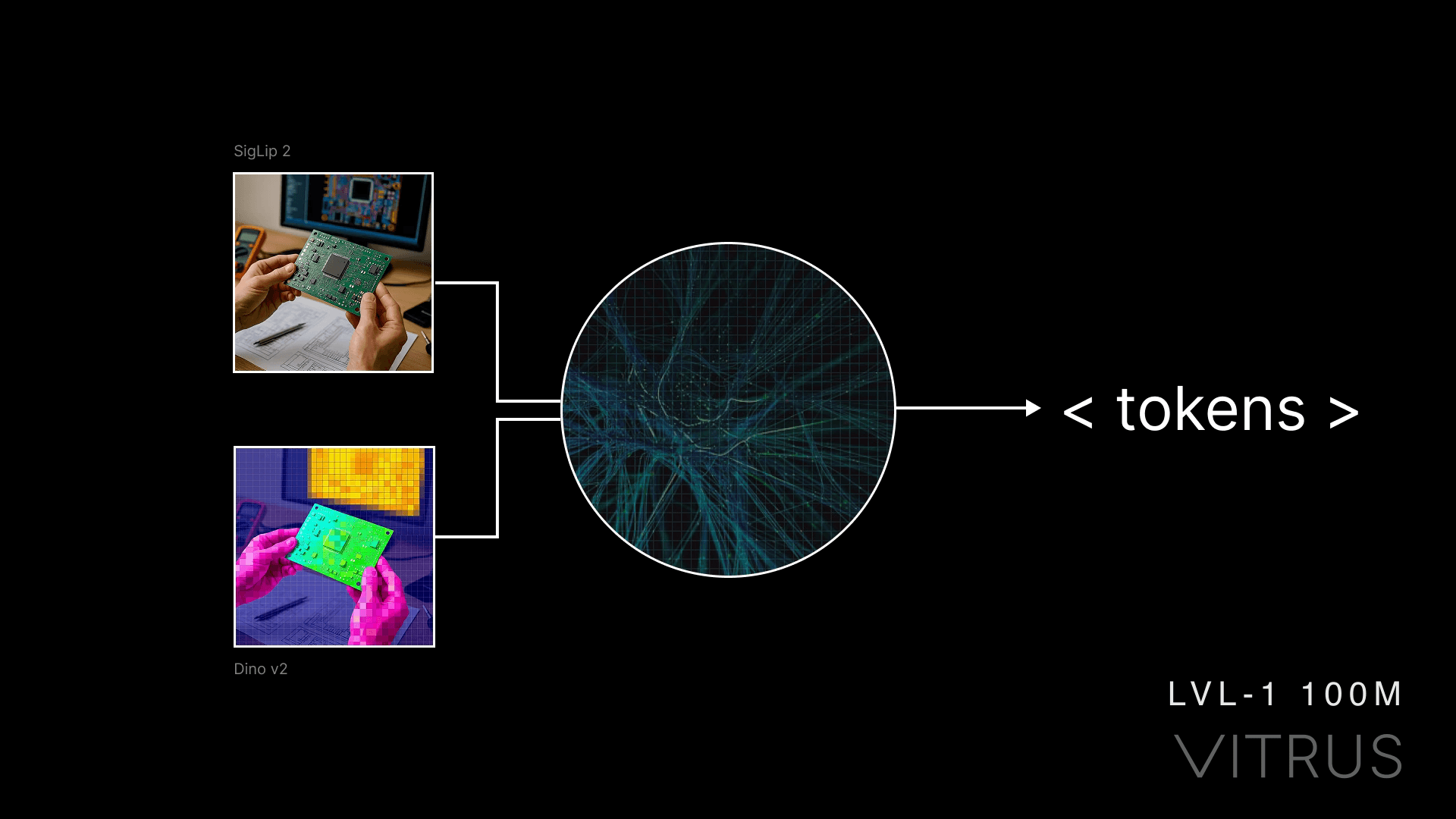
This bottleneck is the central research question. If pooling removes a small tool, a hand-object contact, or an object boundary, the decoder cannot recover it later. A compact VLM therefore succeeds by selecting useful spatial evidence—not by retaining everything the encoders know.
03 / The training signal
Teach the bottleneck what must survive
The <DESCRIBE/> task rewards visible objects, spatial relations, activity, and scene context. The<2D_BBOX/> task asks the same model to retain explicit image-space localization. They share the visual prefix but demand different outputs.
No-image and wrong-image counterfactuals are equally important. They penalize a decoder that can imitate familiar training prose without consulting the current image. Text replay protects the language core from collapsing into a narrow caption template.
The encoder names do not guarantee grounding. Spatial knowledge only reaches the output when the projector, token budget, supervision, and counterfactual tests all preserve it.
04 / Performance
In-distribution speed, measured exactly
Restricting the archived run to 50 held-out real test frames from the same source families represented in training—AgiBot, DROID, RH20T, and Open Images—produces a median 143.122 decode tokens/s and 284.641 ms end-to-end latency on an Apple M4 Mac mini with 16 GB of unified memory. Synthetic and OOD stress images are excluded from this view.
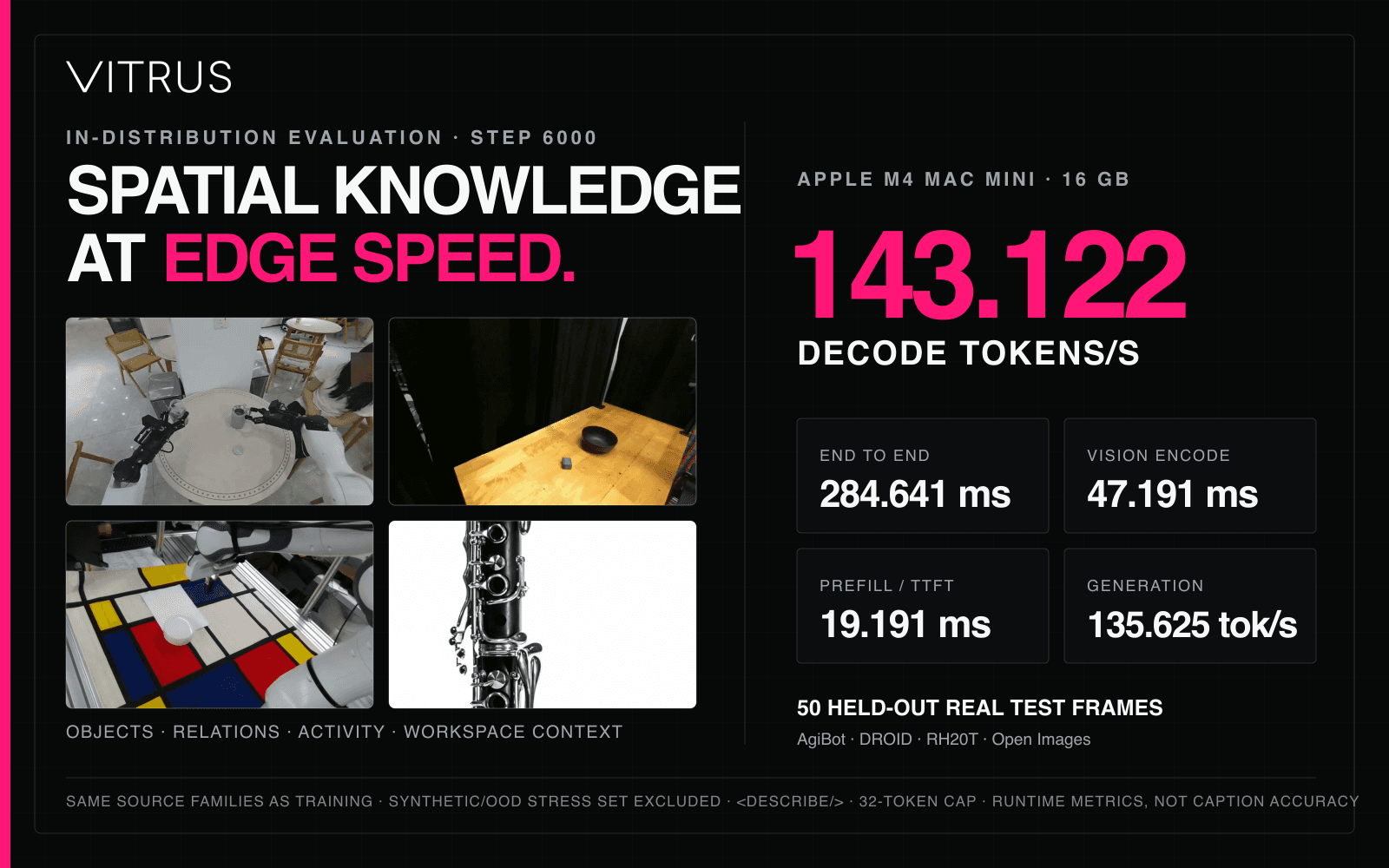
The broader launch benchmark adds 50 synthetic stress images to the same 50 real frames. Every image uses the same <DESCRIBE/> prompt and 32-token cap. The tables below preserve those original, published protocols.
Apple M4 Mac mini
100-image suite · median unless noted
- Decode throughput
- 142.997 tokens/s
- Generation throughput
- 135.470 tokens/s
- Median end-to-end latency
- 284.552 ms
- P90 end-to-end latency
- 286.725 ms
- Vision encoding
- 46.776 ms
- Prefill / time to first token
- 19.197 ms
- Allocated MPS memory
- 441.1 MiB
Raspberry Pi 5
Five warm runs · single evaluation image
- Decode throughput
- 31.807 tokens/s
- Generation throughput
- 22.772 tokens/s
- Warm end-to-end latency
- 2.236 s
- Cold end-to-end latency
- 2.396 s
- Vision encoding
- 1.318 s
- Prefill / time to first token
- 305.856 ms
- Process memory
- 958.1 MiB
The Raspberry Pi result used ONNX Runtime on four Cortex-A76 CPU cores with 8 GB of RAM. Its five-run, single-image protocol is not directly comparable to the 100-image Mac suite. These measurements describe runtime performance, not caption accuracy.
05 / Limits
What 100M parameters can see
LVL-1 can produce useful descriptions of robotics workcells, electronics benches, tools, containers, people, and everyday environments. It also has clear limitations.
The model can repeat objects, miss fine details, hallucinate plausible elements, or lose grounding outside its training distribution. It is not a safety system, a geometric measurement tool, or a robot controller.
The next work is better spatial resolution, cleaner grounded supervision, less repetition, and evaluation that measures whether the model is truly using the image.
06 / Physical intelligence
A local account of a shared world
Vitrus is building machines that need to observe and operate in changing physical environments. We do not expect one small model to understand an entire factory. We expect many specialized observers to contribute evidence to a shared spatial system.
LVL-1 describes what a camera can see. Calibration and geometry establish where things are. VitrusOS maintains state, validates constraints, and controls what machines are allowed to do.
07 / LVL-1 and NVIDIA Cosmos
Two different layers of physical AI
LVL-1 is not a miniature Cosmos. NVIDIA's current Cosmos family targets broad world modeling across language, images, video, audio, and actions. Cosmos 3 connects understanding, generation, simulation, and action in one omnimodal system. LVL-1 deliberately occupies a narrower layer: extracting a compact observation from one image, locally and quickly.
A concrete point of reference is Cosmos-Reason1-7B, which consumes video and text and is trained for physical common sense and embodied reasoning. NVIDIA'sCosmos-Predict2.5 instead uses 2B and 14B models to predict future world states as video. Those are fundamentally broader tasks than LVL-1's single-image extraction.
The systems can be complementary. A Cosmos model can serve as a teacher, reasoner, or simulator upstream; a compact model like LVL-1 can run beside cameras and machines, continuously turning familiar visual scenes into low-cost evidence. The comparison above is architectural—not a quality or speed leaderboard. There is no shared checkpoint, task, hardware, or benchmark that would support a direct score.
Open research release
Build with LVL-1
LVL-1 is available under noncommercial, research-only terms. For commercial licensing and applications, contact Vitrus.